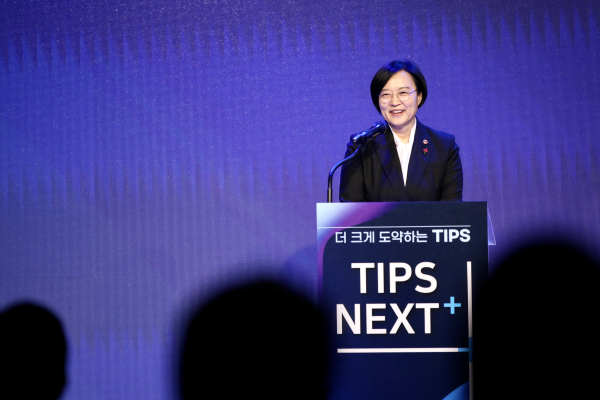
The Ministry of SMEs and Startups (MSS) unveiled its “2026 TIPS Policy Direction,” which focuses on expanding research and development (R&D) support for TIPS companies, strengthening regional incentives, introducing AI-based growth support, and reinforcing global expansion efforts. Through the TIPS Performance Sharing Meeting, the ministry shared future policy directions, including higher R&D support amounts, the introduction of follow-on R&D programs, and expanded support for non-capital-region startups.
On the 18th, MSS announced that it held the TIPS Performance Sharing Meeting at the Four Seasons Hotel in Gwanghwamun, attended by around 400 participants, including TIPS-participating companies, operators, and heads of supporting organizations.
The event was organized to share the achievements of TIPS, which has established itself as a world-class startup support program, and to introduce the “2026 TIPS Policy Direction” aimed at taking the program to the next level.
TIPS is a public-private startup support system in which private operators leverage their expertise and capabilities to select, invest in, and nurture startups, while the government provides linked support such as R&D and commercialization funding.
Over the past 13 years since its launch, approximately 4,400 innovative companies have participated in TIPS, and this year the program surpassed KRW 20 trillion in cumulative follow-on investment.
In particular, the event marked the first-ever selection of “TIPS Company of the Year” and “TIPS Operator of the Year” to further spread exemplary achievements.
The TIPS Companies of the Year were Rebellions, Korea’s first AI unicorn; Bitsensing, which has grown rapidly since launching with TIPS support; and Dreamace, recognized for practicing win-win cooperation through mentoring younger startups.
The TIPS Operators of the Year were Seoul National University Technology Holdings, FuturePlay, and the Chungbuk Center for Creative Economy and Innovation, all of which demonstrated outstanding performance in discovering and nurturing startups.
The event also unveiled growth support measures developed in collaboration with private companies. The VC, an investment database firm, presented data-driven analyses of TIPS performance and offered mid- to long-term policy recommendations. Antock, an AI-based corporate analysis solution provider, introduced the “TIPS Growth Support System” to support the systematic growth of TIPS companies.
Meanwhile, prior to the event, Minister Han Sung-sook held a roundtable meeting with the selected companies and operators of the year to gather opinions on the 2026 TIPS Policy Direction, which she then announced in her opening remarks.
First, the ministry will significantly expand R&D support for TIPS companies. For the first time in 13 years since the introduction of TIPS, the standard R&D support for the general track will be increased from KRW 500 million over two years to KRW 800 million over two years, and a follow-on R&D program worth KRW 1.5 billion over three years will be provided to startups that complete the general track.
At the same time, the minimum investment requirement for TIPS operators will be raised from KRW 100 million to KRW 200 million to expand private capital inflows and strengthen the screening of promising companies. Furthermore, various data from TIPS companies will be analyzed through an AI-based Growth Support System to provide customized support—such as follow-on investment, market access, and pivoting—based on company type.
To expand the number of non-capital-region TIPS companies, up to 50% of selections will be preferentially allocated by region during evaluations, and investment requirements will be eased by 50% compared to capital-region companies (KRW 200 million for capital-region firms vs. KRW 100 million for non-capital-region firms). In addition, the “Welcome to TIPS” program for discovering promising regional startups will be expanded from the existing “five major regions” to a “5 hubs and 3 special zones” system.
The ministry also plans to dispatch a “TIPS Global Delegation” composed of innovative startups to major overseas exhibitions and networking events to support the formation of global networks with foreign buyers and venture capital firms.
When senior TIPS companies independently plan growth support initiatives—such as mentoring for junior startups—the government will support these efforts to spread a “Pay-it-Forward” culture throughout the TIPS ecosystem.
In addition, an ESG category will be newly introduced in the company selection process to give priority to ESG-focused companies, such as climate tech and social ventures, and the adoption of retirement pension systems will also be considered.
The regional councils established last year will be expanded into a policy partner organization called the TIPS Council. Going forward, companies, operators, and supporting organizations will jointly share opinions through the council during policy implementation. The ministry will also simplify evaluation procedures to reduce the burden on companies while strengthening fairness and professionalism in evaluations.
Minister Han Sung-sook stated, “As the global economic paradigm is being reshaped by a major technological transformation centered on AI and deep tech, the potential of innovative startups such as TIPS companies is more important than ever,” adding, “We will concentrate our policy capabilities to ensure a greater leap forward for TIPS and Korea’s startup ecosystem.”
